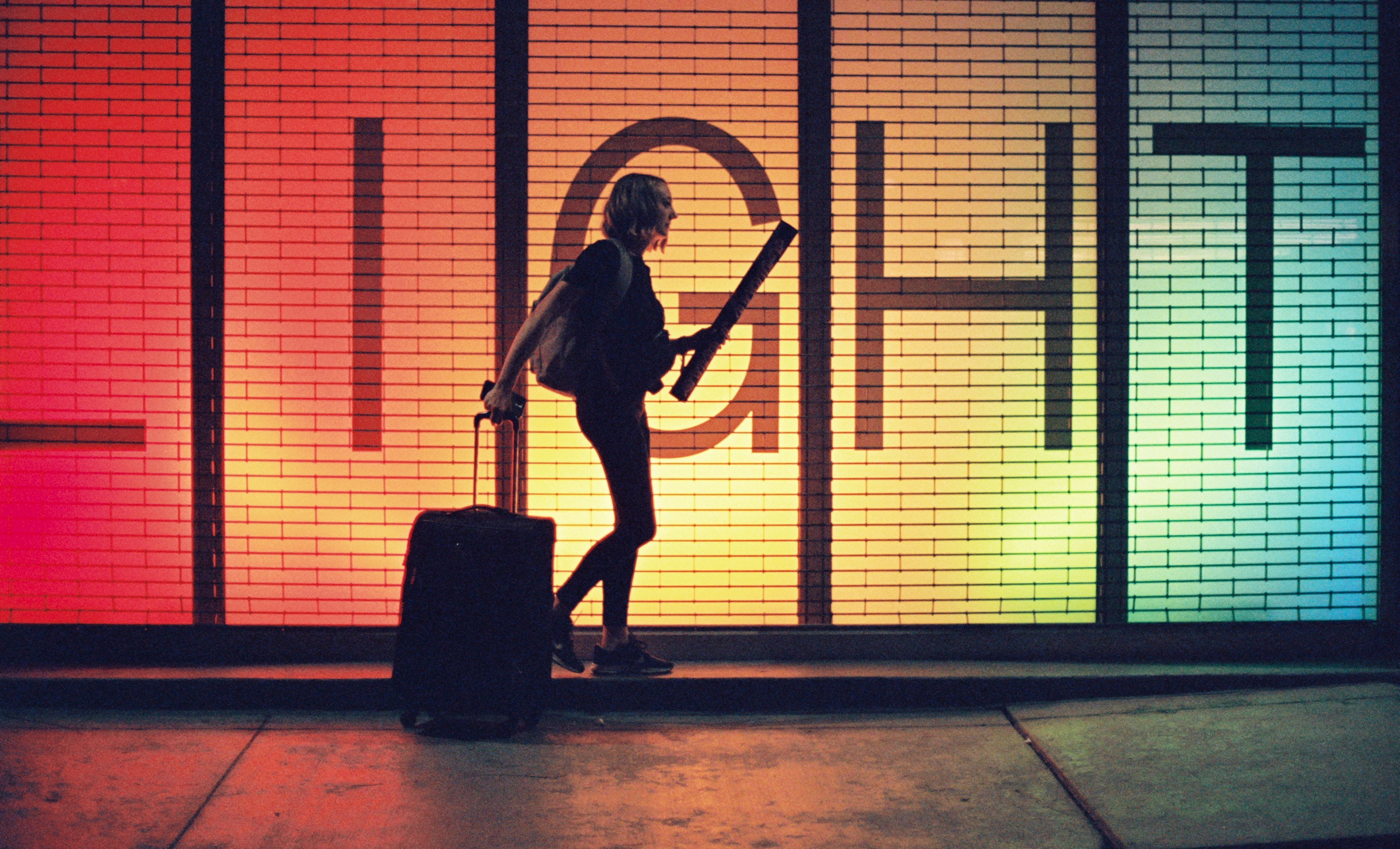

“The truth isn’t always the moral compass or the just thing, but instead a culmination of every involved party’s self-interest, and unfortunate civilians who are stuck in between.”
GOOD MORNING VIETNAM!
I already miss sending the meme of Robin Williams to everyone each morning, but coming home means a new blog so aren’t you all so lucky.
Trigger warnings: war, violence, torture, trauma
Vietnam has a long and complicated history. While I will touch on many subjects here, I urge you to go and research even more as there is so much to cover and alas I am just a girl.
Getting to the literal other side of the world was a feat in itself, especially for us scoliosis girlies in economy. Bright and early, I took an uber to 30th street Philly, an Amtrak to NY Penn Station, the E train to the JFK Air Tran, then a 16 hour flight to Seoul, South Korea, followed by another 4 hours flight to Hanoi, Vietnam. You really need to want it.
The name Vietnam comes from two words: Viet & Nam. Viet refers to a group of people, while Nam refers to the south. Together it reads as a group in the south of man (China). Although they were under Chinese rule in BCE and CE, Vietnamese can find this name meaning offensive as they are not a part of China and instead their own country.
On our first full day, we rode a river boat on the Saigon River to the Cu Chi Tunnels for a tour. The tunnels of Củ Chi (Vietnamese: Địa đạo Củ Chi) are an immense network of connecting tunnels located in the Củ Chi District of Ho Chi Minh City (Saigon). The tunnels were used by Viet Cong soldiers as hiding spots during combat, as well as serving as communication and supply routes, hospitals, food and weapon caches and living quarters for numerous North Vietnamese fighters.
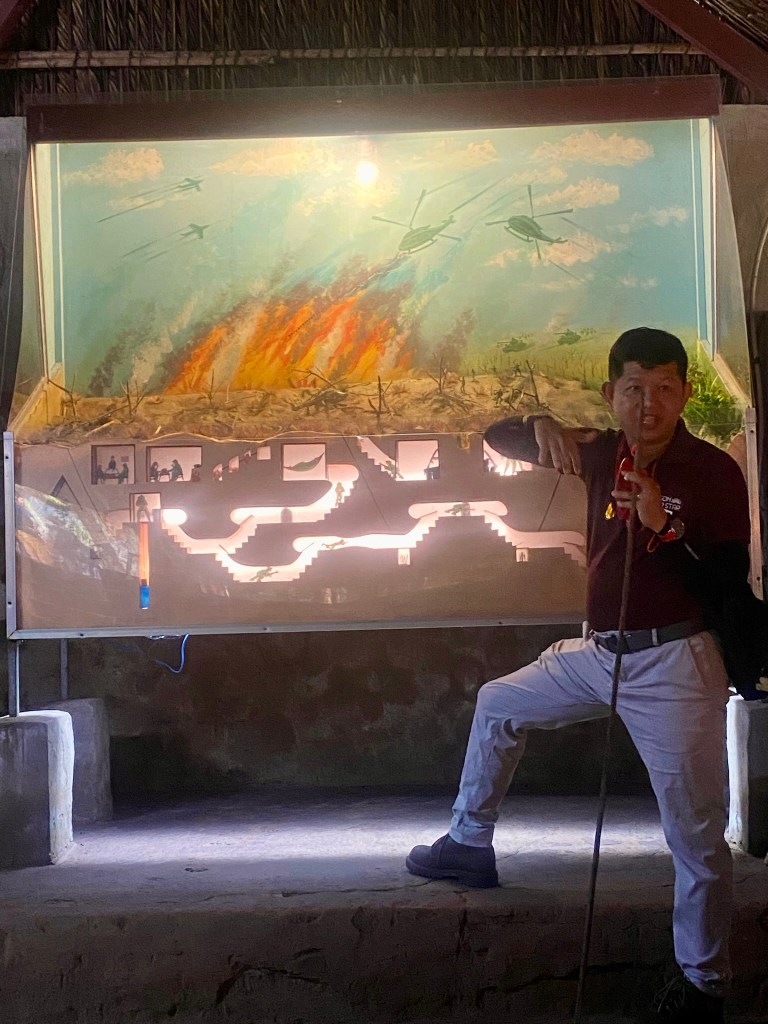
Let’s take it back a bit here first. Many Americans when thinking of Vietnam first think of the Vietnam War, or as it is referred to in Vietnam as The American War. Before that war, there were multiple other wars, colonizations, overtakings, and so on.
In 1883, Vietnam became part of the French colonization, and Vietnam’s territory was integrated into French Indochina. I’ll talk more on this era in a different blog, specifically about “Maison Centrale,” the infamous Hoa Lo Prison in Hanoi, built by the French colonialists from 1896 to 1901 to hold Vietnamese political prisoners, that I toured on my final day of the trip.
During World War II, Japan occupied Vietnam. On 9 March 1945, the Japanese removed Vichy France’s control of Indochina. Japan’s defeat by the World War II Allies created a power vacuum for Vietnamese nationalists of all parties to seize power in August 1945. On 2 September 1945, Ho Chi Minh of the communist Viet Minh read the Proclamation of Independence of the Democratic Republic of Vietnam (DRV), officially creating the Democratic Republic of Vietnam.
France attempted to regain control, leading to the First Indochina War, which resulted in Vietnam’s division in 1954. The division into North and South Vietnam led to the Vietnam War (1954–1975), a protracted conflict between the communist North and its allies and the government of South Vietnam and its allies, primarily the United States. This now brings us back to the Cu Chi tunnels, where the Viet Cong, a communist-led guerrilla force in South Vietnam, fought against the South Vietnamese government and its U.S. allies during the Vietnam War. This battle was about political ideologies, and for the United States and other countries involved it was about continuing or stopping communism.
Just like in America, history is taught differently depending on the state, city, or even country you reside. We can sit here and fight over who the “winner” was, but in war there is no winner, just losses.
Like every war in history, there are 3 sides to the story. The two opposing sides and then the truth in the murky middle. The truth isn’t always the moral compass or the just thing, but instead a culmination of every involved party’s self-interest, and unfortunate civilians who are stuck in between.
The Viet Cong were an extremely intelligent army. Although they did not have the resources like the American armies, they built an elaborate network of tunnels filled with bunkers, escape plans, kitchens, and more so they were hidden from sight. It was like fighting a ghost.
“Walking without a trace, talking without noise.”
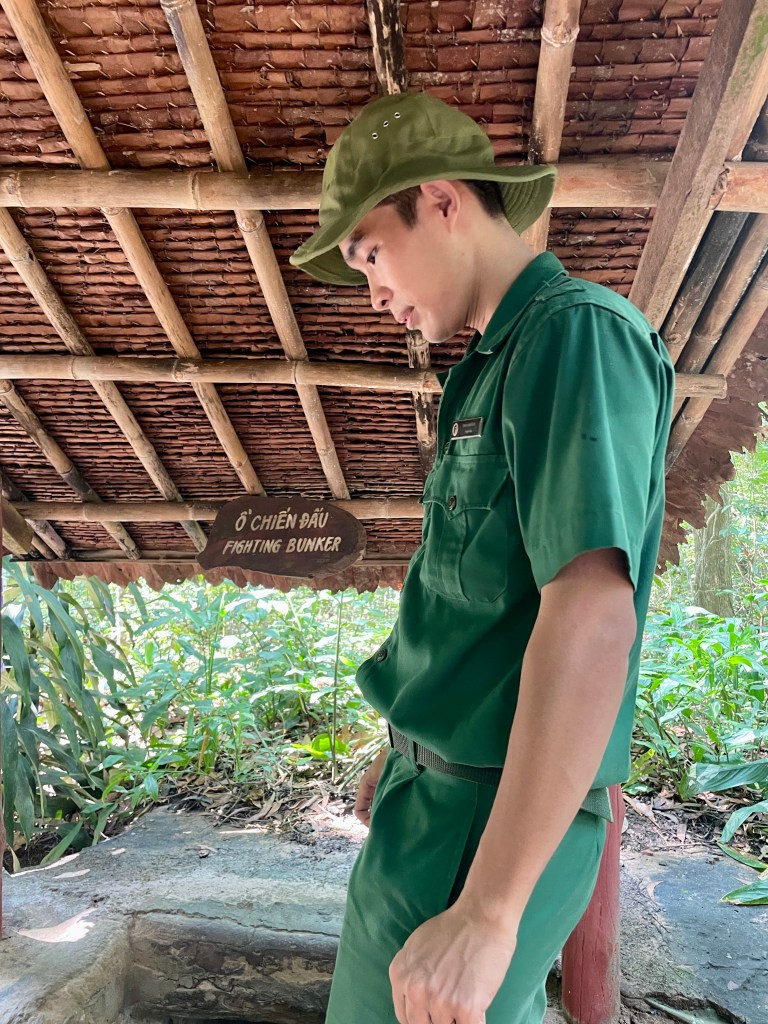
Their outfits were dark and they only traveled at night. They work checkered scarfs to help identify themselves. When Southern spies tried to infiltrate their ranks by dressing the part, they made an elaborate tie with their scarves that only they could replicate, snuffing out spies easily.
In the 1956s, once the Americans discovered the tunnels, they brought over 100+ German Shepards and of course gases. The Viet Cong in response would take chunks of dead Americans and hide them in other places to throw off the dog’s scent.
You may be asking if they were so stealthy, then how did they go to the bathroom and where did they put the waste? Ammunition boxes were used as toilets and then buried in the 3rd level of the tunnels, completely sealed off from the dogs and their own nostrils.
What about the dirt used to make the tunnels? Surely that would have been a dead give away. The dirt to carve the tunnels was used to fill into bomb craters, thus seeming as if nothing had ever happened, keeping the tunnels a secret.
This also meant that everything you did had to be done underground. Cooking would happen at night and the chimney of smoke would be located up to 100 meters away just in case someone spotted the smoke rising above the ground.
When women had their periods, they had to stay under the tunnels the entire time so as not to grab the dog’s attention. This also meant anyone giving birth did so in the tunnels. On our tour we passed by a man who was actually born inside the tunnels.
The Viet Cong would use the rubber from truck tires to create sandals. They would create the sandal to be worn to look like toe for heel and heel for toe. This way when leaving footprints, a tracker would be sent in the completely opposite direction. Again, think smarter not harder.
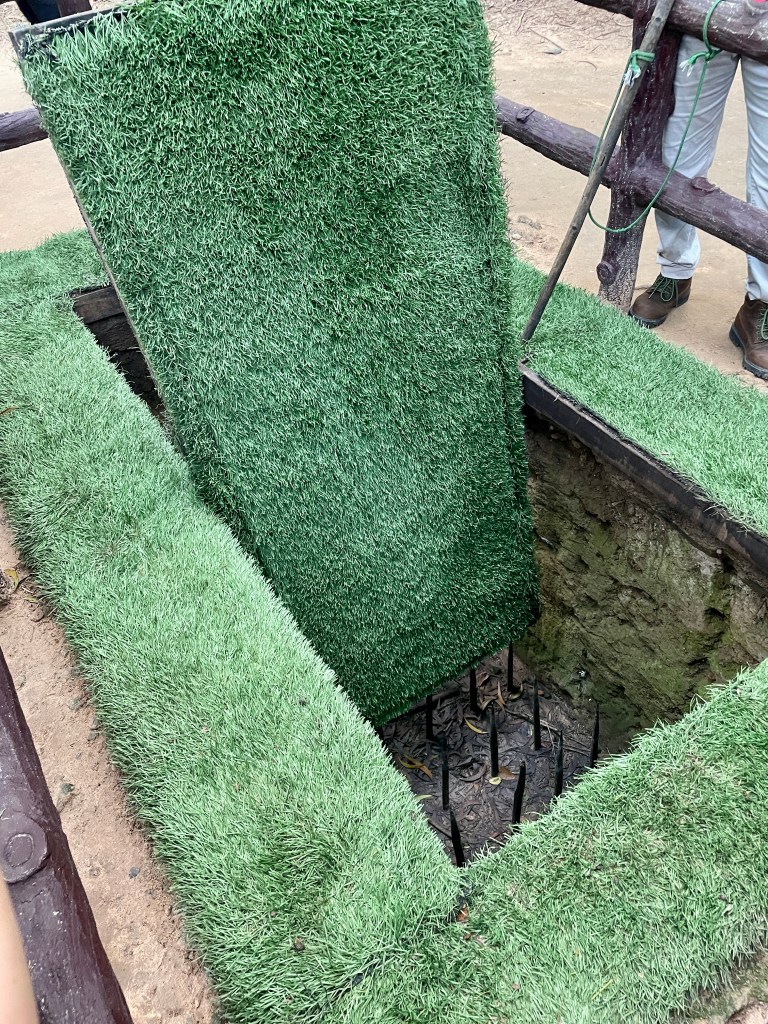
Walking around, you notice a ton of booby traps, created out of fallen missiles and materials. The goal of the booby traps was not to kill, but just to injure. The Viet Cong understood they did not have the manpower to take on the Americans directly, but knew that the Americans never left a man behind. When one member of the unit was injured, the whole unit would come to their rescue, making it much easier then for the Viet Cong to attack.
The most insane part of the entire tour, is that there is a gun range located on the property. Vietnam has some of the strictest gun laws in the world, with private ownership generally prohibited and weapons strictly for national defense and security. Tourists can fire off ammunition within the gun range, leading to hearing multiple gun shots as you tour the tunnel system, which is extremely eerie.
Apparently you used to be able to pick up the gun and shoot it at the range, but one day a man pointed the gun at his girlfriend’s head during a fight, so now it is glued to the table and you must use it stationary to shoot. Again, the audacity of men. They really do ruin everything.
The last thing you begin to notice is the lack of bird noises. Unfortunately most species of birds were wiped off due to the use of agent orange.
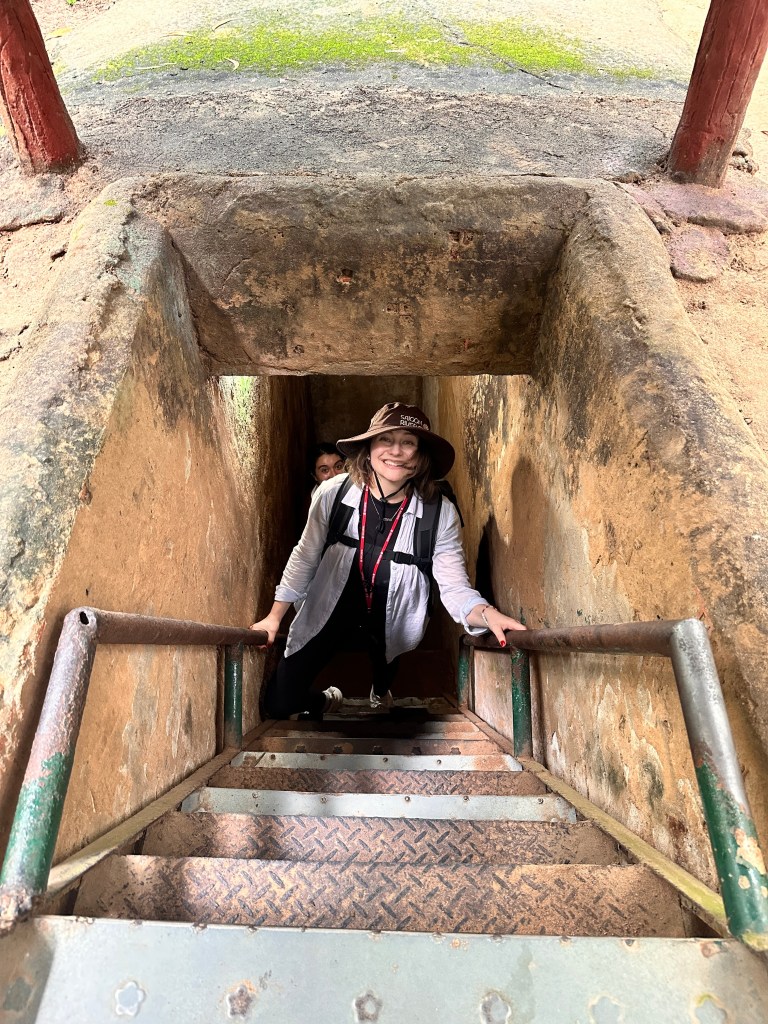
There is still so much more to talk about here, but more coming soon in the next post. Until then please enjoy this photo of me getting stuck in the Cu Chi tunnels…

And this picture of me with the size 5 dilator at the local farm…


 Bonnie Gross
Leave a reply to Judy Wisniewski Cancel reply