“A door has always been seen as a portal, an entrance or an exit. Metaphorically speaking this can lead to another world, a new beginning or opportunity, and even mark the end of a chapter and death.”
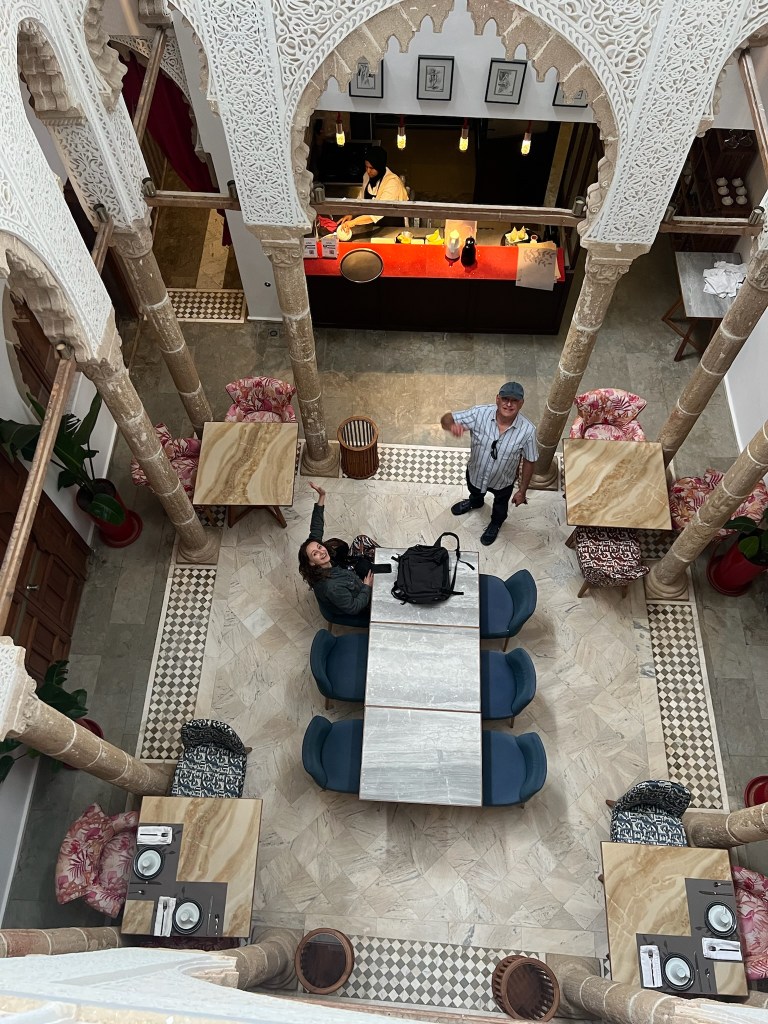
After Casablanca, we drove to Rabat to stay overnight in a Riad, in the center of the medina (we will get into medinas later). A Riad is a traditional Moroccan house, often used as a hotel, characterized by an interior garden or courtyard with an open roof. It offers a tranquil oasis amidst the bustling medinas and a close connection to nature.
The next day we started our tour with Ikram, an awesome Rabat local. Our first stop was the royal palace The Royal Palace or Dar al-Makhzen which is the primary and official residence of the king of Morocco in Rabat. When most of Morocco came under French control in 1912, the colonial administration wanted the sultan to be largely stationed in one place, near their administrative headquarters, to show his acceptance of the new regime. Although kings had many residences at their disposal when independence was declared in 1955, they chose to keep the Dar al-Makhzen palace as the main palace of the monarch.
As I mentioned earlier the royal family is very private, so the palace grounds are not only a living space for the king and the royal family and accommodation for the Moroccan Royal Guard, but also contains the Collège Royal, a school for senior members of the royal family, a cookery school, and a ground floor library built to contain the manuscript collection of Hassan II. There is even a royal pet cemetery.
Upon ascending to the throne, the current king, Mohammed VI, initially introduced several reforms and changed the family code to grant more rights to women in Morocco. The big change was that men could no longer take on multiple wives without the first wife’s permission. You can imagine most wives said no to another wife. His progressive views were looked down upon by more conservatives and fundamentalists, but created a more equitable Morocco than any previous generations.
He was also the first to marry outside the royal family to his wife Salma Bennani, who was also the first wife of a Moroccan ruler to have been publicly acknowledged. Typically the wives would not be seen publicly, but instead Salma was spotted in public regularly. She belongs to the Fez branch of the Bennani family – a prominent family originally belonging to the social category of bildiyyīn (“people of the town”) who were Jewish converts from Fez to Islam. These were all big firsts!
He was also the first king to designate Amazigh as an official national language, along with standard Arabic. The Amazigh people (Imazighen), the natives, have been in North Africa for millennia, predating the Arab conquest of the region. These peoples are also known as Berbers or the Berber peoples. Berber kingdoms were eventually suppressed by the Arab conquests of the 7th and 8th centuries AD.
While Berber is more widely known among English-speakers, its usage is a subject of debate, due to its historical background as an exonym and present equivalence with the Arabic word for “barbarian.” The Romans even referred to them as barbarians. Just as conquerors referred to the native peoples as barbarians throughout history, we are seeing the pattern repeat again here. Back in the Berber era, ascension of the throne was both women and men, mainly queens, but now is only through the men of the family, thus preserving the last name.
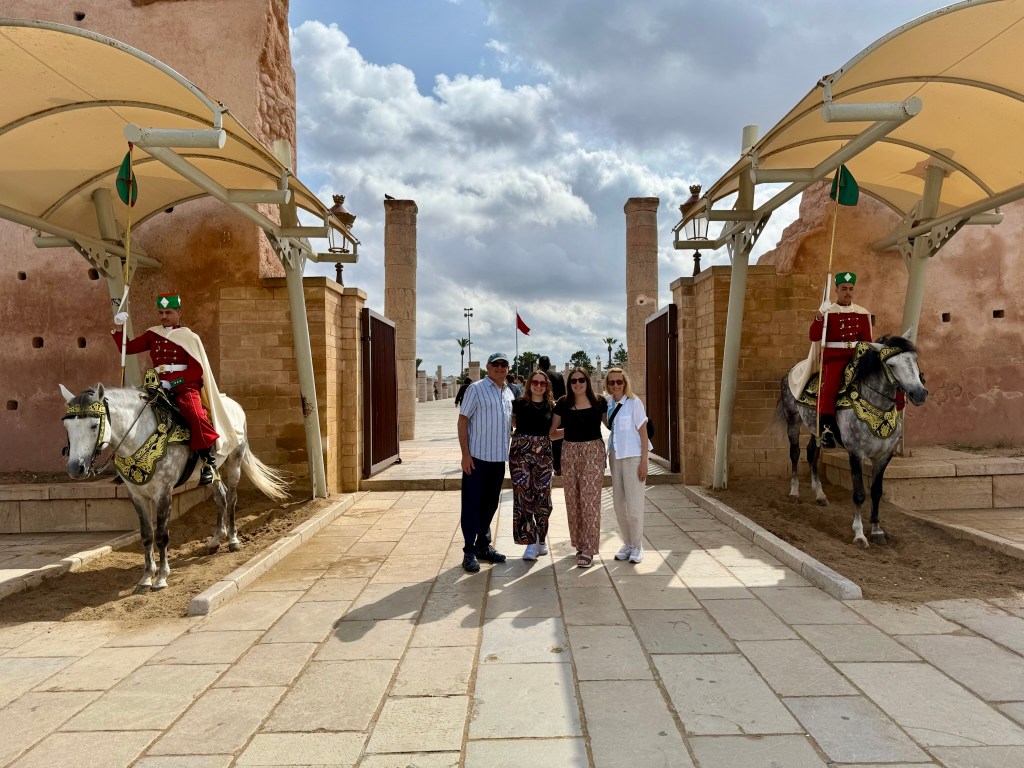
We then moved to Hassan Tower, the minaret of an incomplete mosque from the 12th century. The tower was intended to be the largest minaret in the world. When al-Mansur died in 1199, construction on the mosque stopped. The minaret was left standing at a height of 44 meters and the rest of the mosque was also left incomplete, with only the beginnings of several walls and 348 columns being constructed. The area also includes The Mausoleum of Mohammed V which contains the tombs of the Moroccan king Mohammed V and his two sons, late King Hassan II and Prince Abdallah.

The holes in the walls were actually more than pigeon hangouts, they were used for scaffolding. Also the tower features ramps spiraling up, which were actually for horses to get up and down to bring building materials. People were building scaffolding back then, and I can barely put together a desk from IKEA.
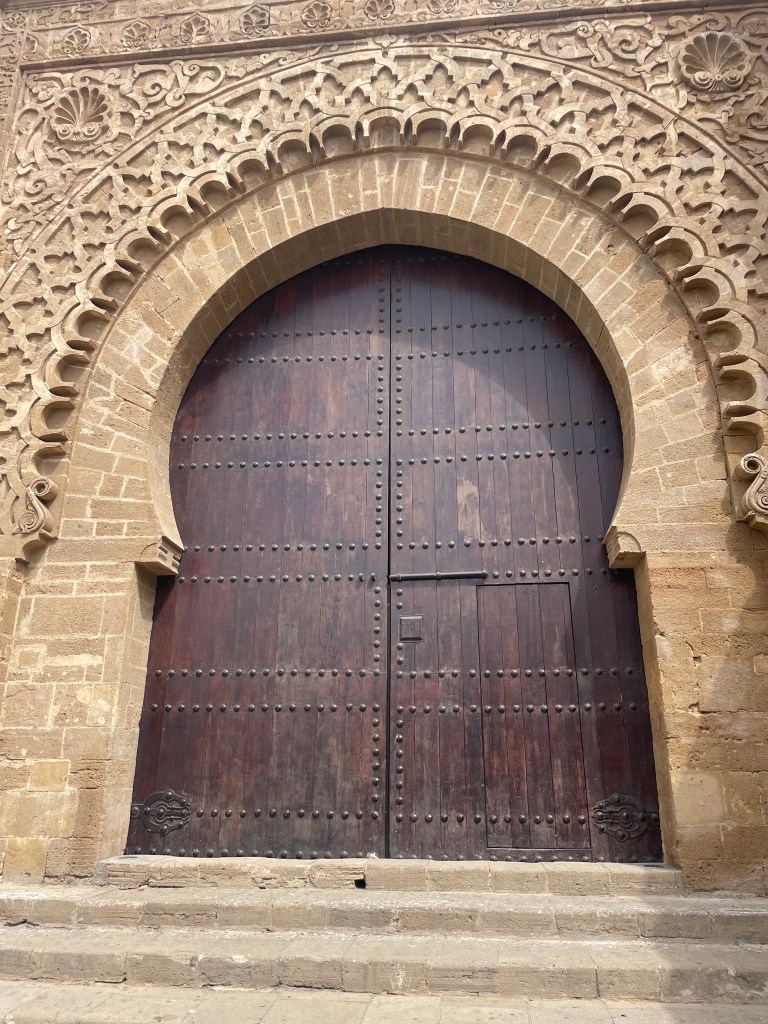
You will notice that all the patterns in the tiles and mosaics are geometric patterns or florals. There are never any humans or animals depicted. This is due to the Islamic belief that you cannot imitate the job of God, therefore no faces are to be created in the art.
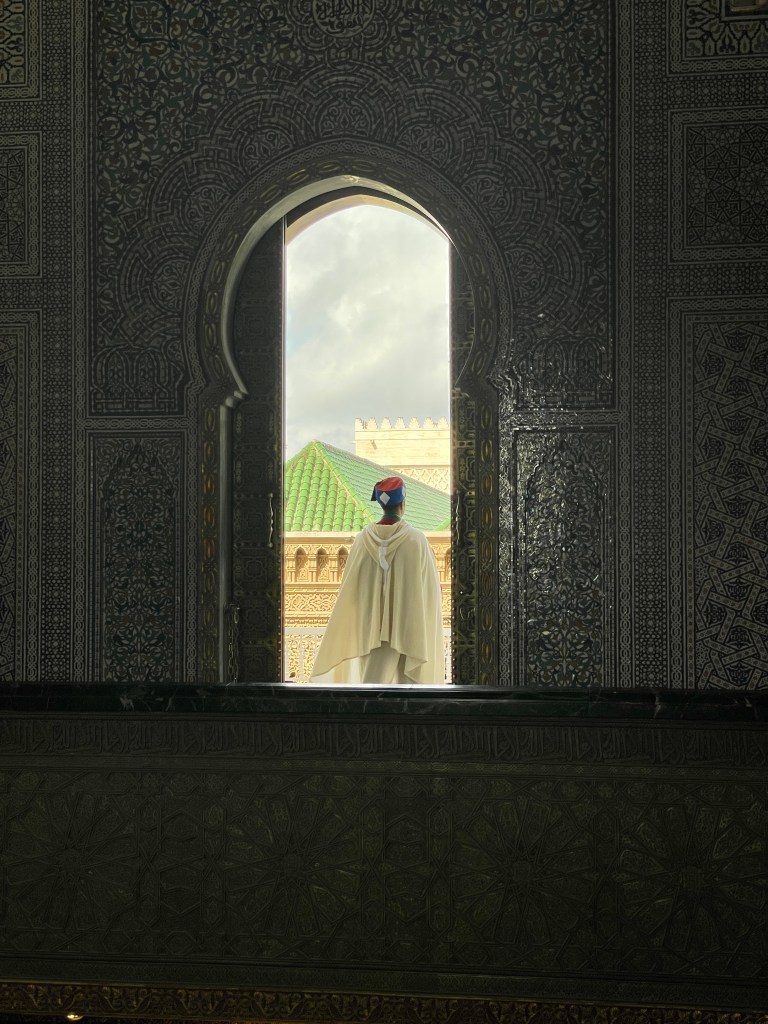
The horses that stand guard outside the tower are actually The Berb Horses, indigenous horses of North Africa. Just like the royal family, the horses all descend from the same bloodline. The Royal Guard stands guard over and also performs a changing of the guard.
We then moved onto the medina, which again you will hear about a lot in these blogs. In Morocco, “medina” refers to the historic, walled old city, typically found in the center of a city. It’s a maze of narrow, winding streets, often car-free, where traditional architecture, markets (souks), mosques, and religious schools (madrassas) are located. In Moroccan cities, a kasbah is a fortified citadel or historical and political center, often with military installations, while a medina is the older, bustling part of the city with narrow streets, shops, markets, and traditional residential areas. As with most themes here the French mistranslated the term kasbah, and would use the term to refer to small communities instead.
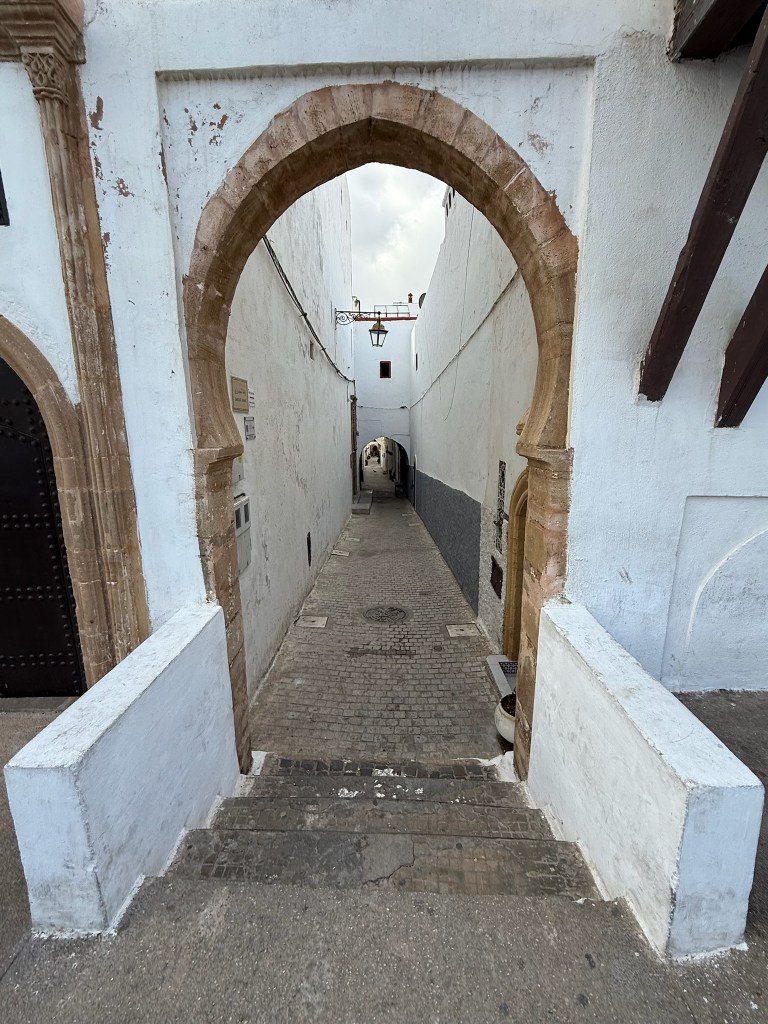
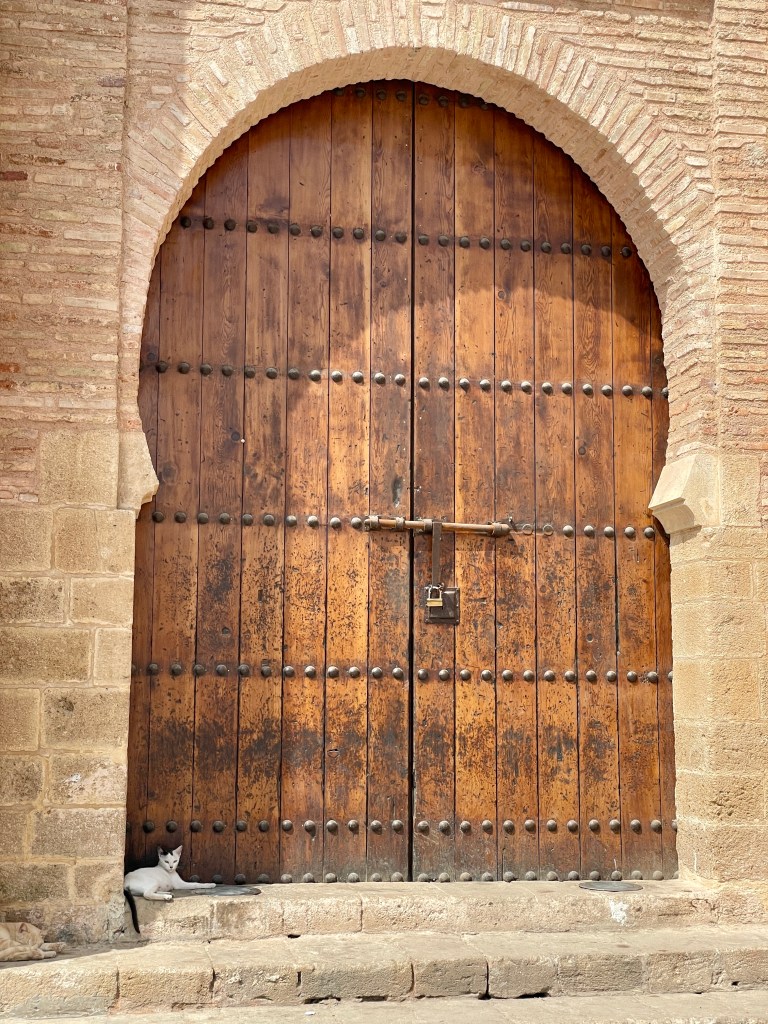
You will see a lot of doors that are in a keyhole shape. The first third is a circle, the next third is the rest of the heigh to the ground and the third part is underground. These are not only a sign of openness, but also reflect the houses of God. A door has always been seen as a portal, an entrance or an exit. Metaphorically speaking this can lead to another world, a new beginning or opportunity, and even mark the end of a chapter and death.
Rabat was founded by the Phoenicians in the 1st millennium BC, under the name of Sala, this promising city soon came under the hungry gaze of an expansionist Rome. At the time of Rome’s annexation of it in the 1st century BC, it was controlled by an ancient Berber kingdom. The Spanish Inquisition, particularly after 1492, forced Muslims and Jews in Spain to convert to Christianity or face expulsion. The influx of Spanish Jews significantly increased the Jewish population in Morocco, which had a long history of Jewish presence.
Rabat’s twin city, Salé, became a major base for Barbary corsairs (pirates) starting in the 17th century. Barbary pirates, including the Salé Rovers, captured Europeans and sold them into slavery in North Africa. This trade, lasting for centuries, resulted in the enslavement of hundreds of thousands, possibly over a million Europeans. The Andalusian Gardens you are about to see were built by white Spanish slaves.
After our tour, we ate dinner at our Riad, which featured a traditional Moroccan dish, tagine. The name comes from the tagine pot that the dish is cooked in. The concept of cooking in a tagine appears in the famous One Thousand and One Nights, an Arabic-language story collection from the 9th century. According to the historian of Jewish food Gil Marks, the unique two-piece cooking vessel originates from the Anti-Atlas Mountains in Morocco. The domed or cone-shaped lid of the tagine pot traps steam and returns the condensed liquid to the pot. The sweet and sour combination is common in tagine dishes like lamb with prunes and spices. There was a common tagine served of chicken with lemon and olives.

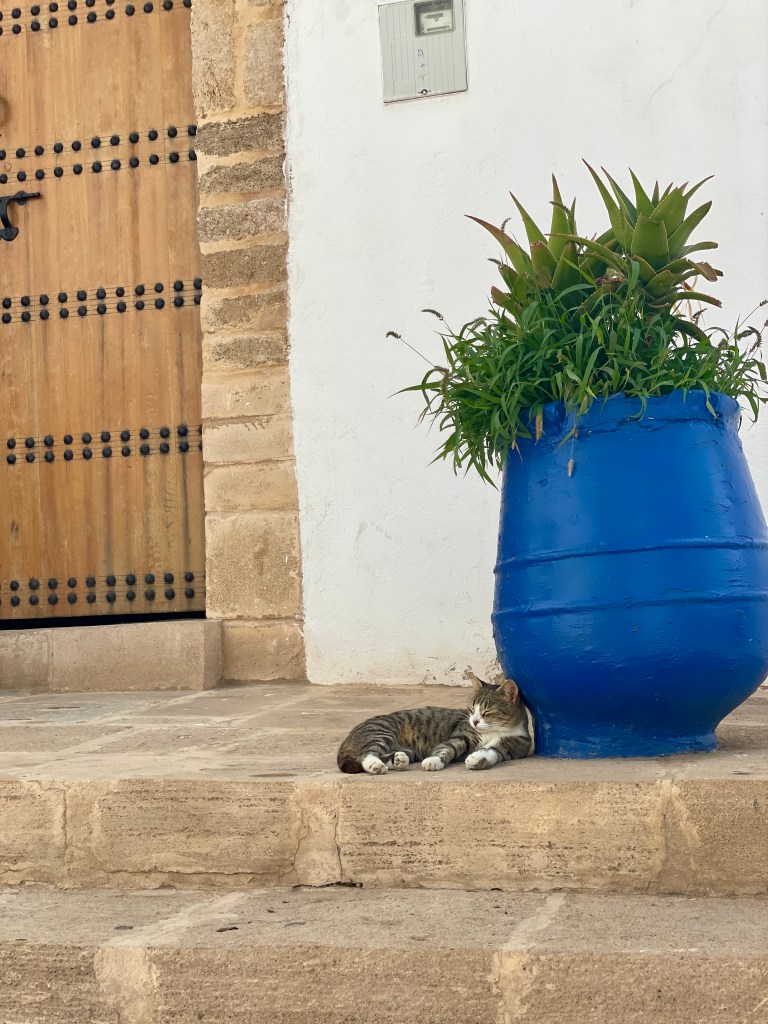
Not to overload you all on history, I’ll stop here for now. Our next stop is Tangier, but until then please enjoy this photo of cats perfectly posing in Rabat doorways…
 Bonnie Gross
Leave a comment